
食神
Unitree IPO draws spotlight to China's fast-growing humanoid robot sector_我的网站

A |
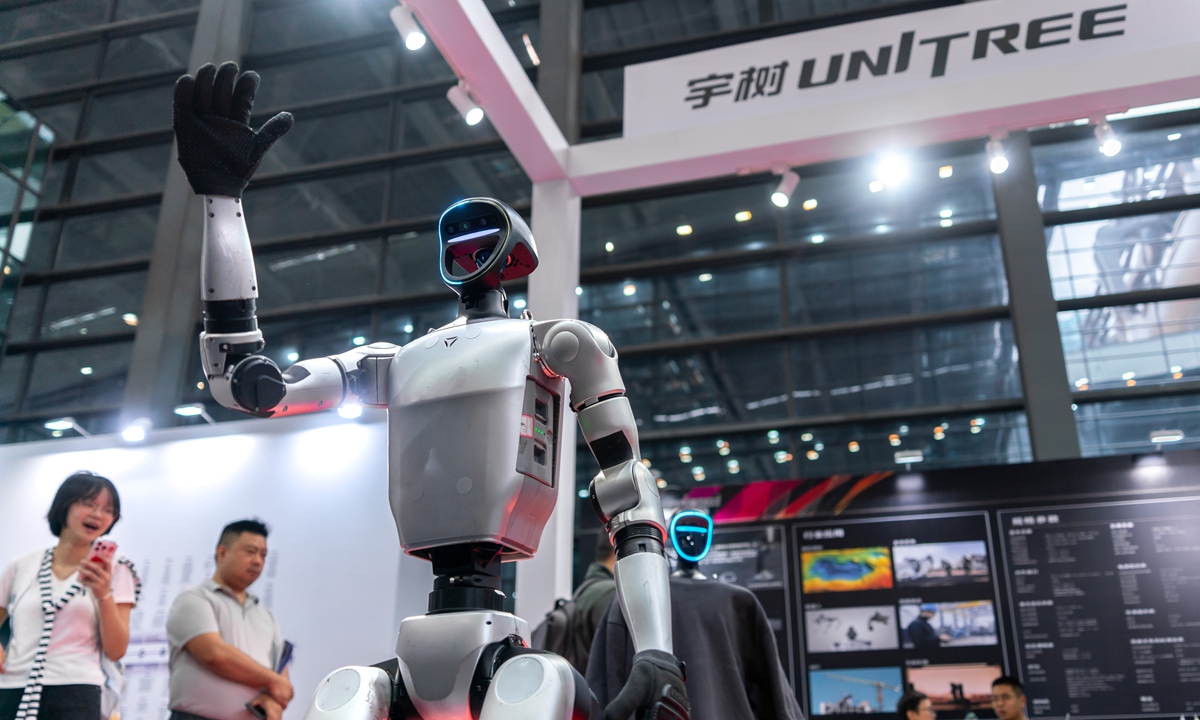
Chinese robot maker Unitree Robotics on Monday opened subscriptions for its initial public offering (IPO) on the Shanghai Stock Exchange's STAR Market, putting a leading player in China's fast-growing humanoid robot industry in the capital-market spotlight.
The Hangzhou-based company is offering about 40.45 million shares at 150.80 yuan (about 22 U.S. dollars) each, representing 10 percent of its post-offering share capital. The offering is expected to raise about 6.10 billion yuan in gross proceeds.
The offering drew overwhelming interest during preliminary price inquiries. After invalid bids and the highest-priced portion of proposed subscriptions were excluded, the remaining proposed offline subscriptions totaled 71.46 billion shares, 2,760.67 times the initial offline offering size before adjustment for strategic placement, according to the issuance announcement.
Founded in 2016 as a civilian robotics company, Unitree has established leadership in core robot parts, motion control, robot sensing and other comprehensive fields, focusing on high-performance general-purpose humanoid and quadruped robots, robot components and embodied intelligence models.
The company's prospectus shows that from 2023 to 2025, Unitree sold 33,294 quadruped robots and 5,632 humanoid robots. Its humanoid robot shipments exceeded 5,500 units in 2025, excluding wheeled dual-arm robots.
Unitree's revenue rose to 1.70 billion yuan in 2025 from 392.77 million yuan in 2024 and 159.13 million yuan in 2023. It posted a net profit of 278.21 million yuan in 2025, while the net profit attributable to the parent company after excluding non-recurring items stood at 590.75 million yuan, according to the prospectus.
Overseas sales remain an important part of the business, generating revenue of 731.66 million yuan in 2025 and accounting for 43.65 percent of its main-business revenue.
Having gone through the STAR Market's pre-review mechanism, the company saw its IPO application accepted by the Shanghai Stock Exchange on March 20 and approved by the listing committee on June 1, a span of just 73 days, marking a record pace, according to the China Securities Journal.
Unitree's IPO comes as robotics, AI-related products and innovative drugs are emerging as three new drivers of China's export growth, following the previous "new three" of electric vehicles, lithium batteries and photovoltaic products.
Trade data underscores the momentum. China became a net exporter of industrial robots for the first time in 2025. In the first half of 2026, its industrial robot exports reached 6.29 billion yuan, up 18.6 percent year on year, with products shipped to 141 countries and regions, while intelligent biomimetic robot exports exceeded 10,000 units, according to customs data.
Minister of Science and Technology Yin Hejun has said the three emerging sectors are developing rapidly and could become new pillar industries. Their rise points to a structural shift in China's trade advantages, as the country's global economic engagement increasingly extends beyond manufactured goods to technologies, digital capabilities and services.
Unitree plans to invest about 4.20 billion yuan of IPO proceeds in four projects covering intelligent-robot model research, robot-body research and development, new intelligent-robot products and an intelligent-robot manufacturing base.
The projects are intended to strengthen the company's research capabilities, expand production capacity and accelerate the application of general-purpose robots across more scenarios, according to the prospectus.
Brokerages including China Securities Co., Ltd. and Wanlian Securities have highlighted 2026 as a key year for humanoid robot applications and commercialization. China Securities Co. expects improving generalization capabilities to support broader deployment in industrial and commercial scenarios, while Wanlian Securities sees the year as a key window for mass-production validation and real-world scenario deployment.
。 世界上大约7000种已知的语言中,有将近一半的语言,也就是其中的十分之四是口耳相传,没有包含书面内容。这些无文字的语言给现代机器学习翻译系统带来了一个独特的问题,因为它们通常需要在翻译到新语言之前将口头语言转换为书面文字,并将文字还原为语音,但Meta公司已经通过其最新的开源语言AI进展解决了这个问题。作为Meta公司通用语音翻译器(UST)项目的一部分,该项目正致力于开发实时语音到语音的翻译,以便元宇宙居民能够更容易地进行互动(读作:互相进行性骚扰)。作为这个项目的一部分,Meta的研究人员研究了福建闽南话,这是一种散居在亚洲各地的无文字语言,也是台湾地区的主流语言之一。机器学习翻译系统通常需要大量可标记的语言例子,包括书面和口语来进行训练--这正是像闽南话这样的无文字语言所不具备的。为了解决这个问题,"Meta使用语音到单元的翻译(S2UT),将输入的语音直接转换为Meta以前开创的声学单元序列,"首席执行官马克-扎克伯格在周三的一篇博文中解释说。"然后,我们从这些单元生成波形。此外,UnitY被采用为双通解码机制,第一通解码器生成相关语言(普通话)的文本,第二通解码器创建单元。""我们利用普通话作为中间语言来建立伪标签,我们首先将英语(或上面说的闽南话)语音翻译成普通话文本,然后我们再翻译成闽南话(或英语)并将其加入训练数据。"目前,该系统允许讲福建话的人与讲英语的人交谈,尽管很生硬,且该模型一次只能翻译一个完整的句子。但扎克伯格相信,这项技术最终可以应用于更多语言,并将改进到提供实时翻译的程度。扎克伯格宣布,除了Meta已经从这个项目中开源的模型和训练数据外,该公司还将发布一个基于闽南话话语料库的首个语音翻译基准系统,以及"语音矩阵,一个用Meta的创新数据挖掘技术LASER挖掘的语音翻译大料库"。这个系统将使研究人员能够创建他们自己的语音到语音翻译(S2ST)系统。

B |
Current article:http://k5lf0t.aiwengchuanzuodahuai.shop/zlz/20260826/354344.html
Published on:03:05:15